Travel adapters are one of those items you only notice when you don’t have the right one. With more than a dozen plug standards in use worldwide, they are a practical necessity for anyone travelling internationally with electronic devices.
Why Plug Types Still Matter
Despite globalisation, electrical sockets remain stubbornly local, albeit USB charging is becoming more universal but is still not ubiquitous. A laptop bought in the UK won’t fit into a socket in Italy or the US, even though the device itself may be perfectly capable of handling the local voltage. A travel adapter bridges that gap by matching your plug to the socket, allowing devices to be used and charged without modification.
It’s worth noting that adapters only change the physical connection. Most modern electronics are dual-voltage, but higher-powered items may still need a voltage converter.
A World of Plug Standards
International plug standards reflect decades of local engineering choices rather than any global plan.
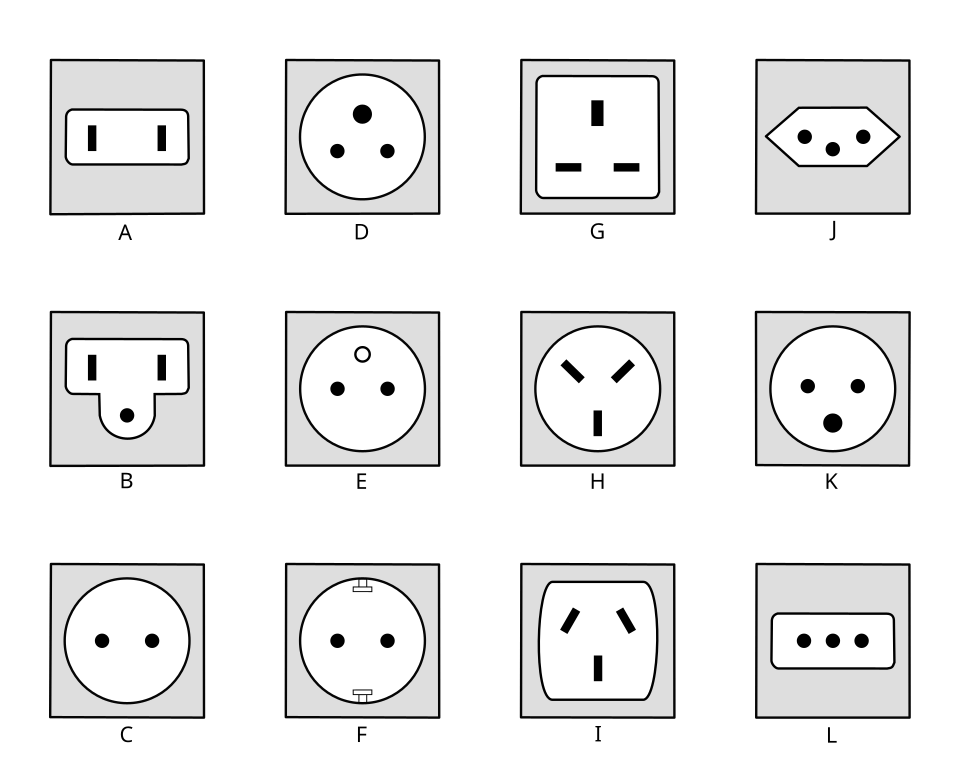
Credit: Yanpas, CC BY-SA 4.0 https://creativecommons.org/licenses/by-sa/4.0, via Wikimedia Commons
As a result:
- Type A: Two flat pins, common in USA, Canada, Mexico, and Japan
- Type B: Two flat pins + round earth pin, common in USA, Canada, and Mexico
- Type C: Two round pins, common in most of Europe, South America, and parts of Asia and Africa
- Type D: Three round pins (triangular), common in India, Nepal, and Sri Lanka
- Type E: Two round pins + earth pin, common in France, Belgium, Poland, and Slovakia
- Type F: Two round pins + side earth clips, common in Germany, Netherlands, Spain, and much of Europe
- Type G: Three rectangular pins, common in the UK, Ireland, Singapore, and Hong Kong
- Type H: Three flat pins, common in Israel
- Type I: Two flat angled pins + earth pin, common in Australia, New Zealand, and China
- Type J: Three round pins, common in Switzerland and Liechtenstein
- Type K: Two round pins + earth pin, common in Denmark and Greenland
- Type L: Three round pins (inline), common in Italy and Chile
Some destinations support multiple plug types (for example, a Type A plug will fit into a Type B socket, but not the other way around), while others use sockets that accept foreign plugs only imperfectly, which can be unreliable. The most common plug types globally are Type A, C, and I, and in countries where these are not the standard, most large or international hotels will often provide compatible sockets or adapters. However, this should not be relied upon, and it is worth checking with https://www.power-plugs-sockets.com being a useful website for this.
The Case for a Universal Adapter
For frequent travellers or multi-country trips, universal travel adapters simplify things. Instead of carrying multiple country-specific plugs, a single adapter covers the major standards. Many also include USB-A and USB-C ports, allowing several devices to be charged from one outlet — increasingly useful as travel becomes more device-heavy.
A well-designed universal adapter balances coverage, size, and safety, making it a permanent fixture in many travellers’ bags
Practical Considerations
Travel adapters are small, but they carry risk if poorly made. Look for:
- Solid construction and firm pin connections
- Built-in protection features
- Clear labelling of supported voltages and wattage limits
Avoid using them with high-power appliances unless they are explicitly designed for that purpose.
Closing Thought
Travel adapters rarely feature on packing lists, yet they quietly enable almost every modern journey. Choosing a reliable universal adapter is a small decision that removes a recurring friction point — and one less thing to think about when crossing borders.
 Holiday Nerd